Introduction
Polyethylene remains one of the most widely used polymers in the plastics industry due to its versatility, cost-effectiveness, and ease of processing. Among its various forms, Low-Density Polyethylene (LDPE) and Linear Low-Density Polyethylene (LLDPE or linear LDPE) are extensively used in films, packaging, coatings, and molded products. Although both materials fall under the same density range, distinct differences exist in their molecular structure, resulting in noticeable variations in physical, mechanical, and processing properties.
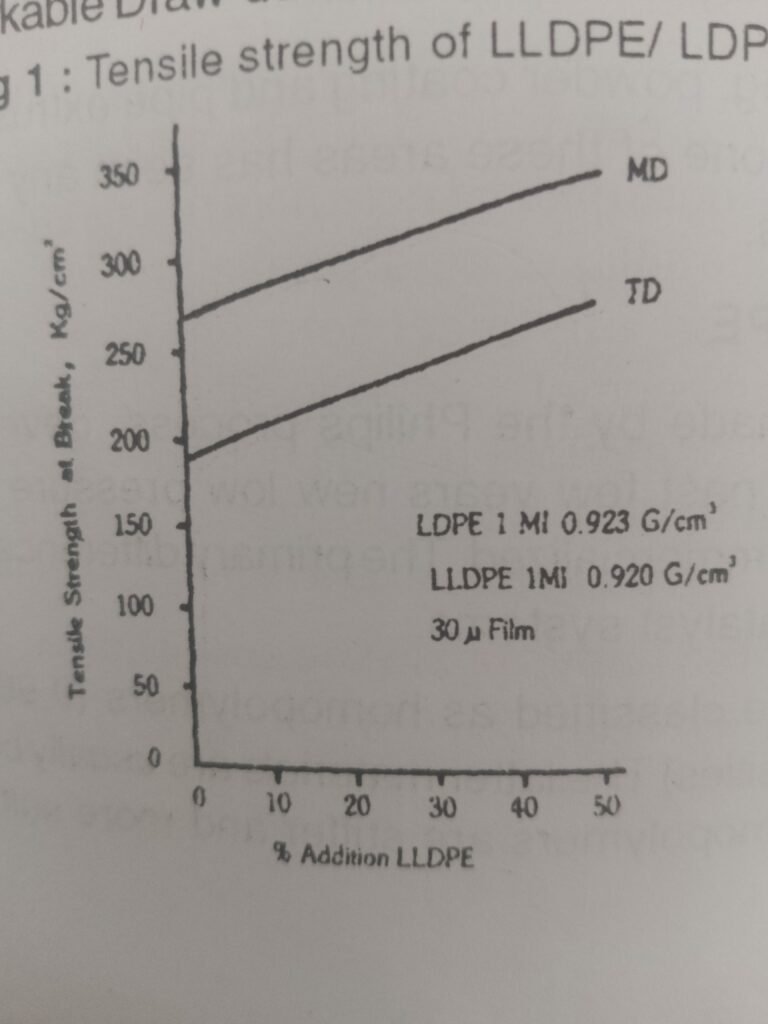
Certain generalizations can be made regarding the properties in which linear LDPE differs from conventional LDPE. Qualitatively, most functional advantages and disadvantages apply to linear LDPE regardless of whether it is produced by gas-phase, solution, or slurry polymerization processes. Minor differences may arise due to process variations; however, the fundamental performance trends remain consistent. When compared to conventional LDPE, linear LDPE exhibits improved puncture resistance, enhanced tear strength, higher melting point at the same density, increased stiffness, sharper melting behavior, greater resistance to warping, improved low-temperature toughness, superior resistance to environmental stress cracking, better flex life, and remarkable drawdown properties.
This article provides a detailed technical and application-oriented comparison of linear LDPE and conventional LDPE, supported by explanations, examples, and tables where appropriate.
Molecular Structure: The Root of Property Differences
The key distinction between conventional LDPE and linear LDPE lies in molecular architecture.
Conventional LDPE is produced using high-pressure free-radical polymerization. This process introduces a significant number of long-chain and short-chain branches along the polyethylene backbone. The result is a highly branched molecular structure with lower packing efficiency.
Linear LDPE, on the other hand, is produced using coordination catalysts such as Ziegler–Natta or metallocene catalysts. Its structure consists of a predominantly linear backbone with controlled short-chain branching introduced through comonomers such as butene, hexene, or octene.
This difference in branching strongly influences crystallinity, intermolecular interactions, and ultimately the mechanical and thermal behavior of the polymer.
Improved Puncture Resistance
One of the most significant advantages of linear LDPE over conventional LDPE is improved puncture resistance.
Due to its linear backbone and uniform short-chain branching, linear LDPE forms tougher crystalline regions connected by strong tie molecules. These tie molecules help distribute stress more evenly when a sharp object attempts to penetrate the film.
In contrast, the highly branched structure of conventional LDPE leads to weaker crystalline regions, making it more susceptible to puncture failure.
Practical Example
In heavy-duty packaging applications such as fertilizer bags, cement liners, and agricultural films, linear LDPE films demonstrate superior resistance to puncture caused by sharp edges or granular contents.
Improved Tear Strength
Linear LDPE exhibits enhanced tear strength in both machine direction (MD) and transverse direction (TD).
The linear molecular arrangement allows for more effective load transfer during tearing, resulting in slower crack propagation. Conventional LDPE, with its random branching, tends to tear more easily once a tear is initiated.
Application Insight
Stretch films and carry bags benefit significantly from this property, as resistance to tearing ensures durability during handling and transportation.
Higher Melting Point at the Same Density
At equivalent densities, linear LDPE typically exhibits a higher melting point than conventional LDPE.
This behavior is attributed to its more uniform crystalline structure. Linear chains pack more efficiently, forming thicker and more stable lamellae that require higher thermal energy to melt.
Processing Advantage
A higher melting point allows linear LDPE films to maintain dimensional stability at elevated temperatures, making them suitable for hot-fill packaging and applications involving heat exposure.
Higher Stiffness at the Same Density
Linear LDPE shows higher stiffness compared to conventional LDPE at the same density.
The reduced long-chain branching increases crystallinity and modulus, resulting in films and molded products with improved rigidity while still retaining flexibility.
Example
In packaging films, higher stiffness enables downgauging, allowing manufacturers to use thinner films without sacrificing performance.
Sharper Melting Point
Linear LDPE exhibits a sharper melting point compared to conventional LDPE, which melts over a broader temperature range.
This sharper melting behavior results from a narrower distribution of crystalline sizes due to controlled short-chain branching.
Impact on Processing
A sharper melting point improves processing consistency during extrusion and film blowing, leading to better control over melt behavior and product quality.
Greater Resistance to Warping
Warping in molded or extruded products is often caused by uneven shrinkage during cooling.
Linear LDPE demonstrates greater resistance to warping due to its uniform crystalline structure and more predictable shrinkage behavior. Conventional LDPE, with its heterogeneous branching, tends to cool unevenly, increasing the risk of distortion.
Application Example
Injection-molded lids, caps, and thin-walled containers benefit from the dimensional stability offered by linear LDPE.
Better Low-Temperature Brittleness Properties
Linear LDPE performs better at low temperatures, exhibiting improved impact resistance and reduced brittleness.
The strong tie molecules between crystalline regions maintain flexibility even in cold environments. Conventional LDPE may become brittle more rapidly as temperatures drop.
Use Case
Frozen food packaging and cold-storage films rely on linear LDPE to prevent cracking and failure at sub-zero temperatures.
Better Resistance to Environmental Stress Cracking (ESC)
Environmental stress cracking is a critical failure mechanism in polyethylene products exposed to stress and chemical agents.
Linear LDPE offers superior resistance to ESC due to its stronger intermolecular bonding and reduced susceptibility to crack initiation.
Industrial Relevance
Containers used for detergents, oils, and agricultural chemicals often incorporate linear LDPE to extend service life and improve reliability.
Better Flex Life
Flex life refers to the ability of a material to withstand repeated bending without failure.
Linear LDPE exhibits superior flex life compared to conventional LDPE, making it ideal for applications involving repeated folding, flexing, or vibration.
Example
Hinged packaging, squeeze bottles, and flexible tubing benefit from the enhanced fatigue resistance of linear LDPE.
Remarkable Drawdown Property
One of the most valuable processing advantages of linear LDPE is its remarkable drawdown capability.
During film extrusion, linear LDPE can be stretched to thinner gauges without breaking. This property is attributed to its high melt strength and uniform molecular structure.
Economic Benefit
Improved drawdown enables downgauging, reducing material consumption while maintaining performance, which leads to cost savings and sustainability benefits.
Comparative Property Table
| Property | Conventional LDPE | Linear LDPE |
|---|---|---|
| Molecular Structure | Highly branched | Linear with short-chain branching |
| Puncture Resistance | Moderate | High |
| Tear Strength | Moderate | Improved |
| Melting Point (Same Density) | Lower | Higher |
| Stiffness | Lower | Higher |
| Melting Range | Broad | Sharp |
| Warping Resistance | Moderate | Better |
| Low-Temperature Performance | Fair | Superior |
| Environmental Stress Crack Resistance | Moderate | High |
| Flex Life | Moderate | Excellent |
| Drawdown Capability | Limited | Remarkable |
Process Independence of Linear LDPE Advantages
Although linear LDPE can be produced using different polymerization processes, such as gas-phase, solution, or slurry methods, the functional advantages discussed remain largely consistent.
Minor differences may be observed in molecular weight distribution, comonomer distribution, and processing behavior. However, these variations do not significantly alter the fundamental performance advantages of linear LDPE over conventional LDPE.
Conclusion
Linear LDPE represents a significant advancement over conventional LDPE in terms of mechanical performance, thermal behavior, and processing efficiency. Its improved puncture resistance, tear strength, stiffness, and environmental stress crack resistance make it a preferred choice for demanding applications. Additionally, superior drawdown capability and low-temperature toughness provide both economic and functional benefits.
While conventional LDPE continues to be used where high clarity and ease of processing are required, linear LDPE has become the material of choice for high-performance films, packaging, and flexible products. Understanding these generalizations enables processors, designers, and engineers to make informed material selections and optimize product performance across a wide range of applications.
About the Author
I am Sujith Shanmugam, a plastics engineer with over 5 years of hands-on experience in polymer materials, processing, and product applications. My work focuses on polyethylene materials, including LDPE, LLDPE, and specialty polymer formulations used in films, coatings, and molded products.
Through this blog, technical concepts in plastics engineering are explained in a practical and application-oriented manner to help students, manufacturers, and industry professionals make informed material and processing decisions.