Introduction
Low Density Polyethylene (LDPE) has been the backbone of the blown film industry for decades. Its excellent melt strength, wide processing window, and forgiving rheology make it ideally suited for conventional blown film lines. However, with increasing pressure on packaging manufacturers to reduce material consumption, improve mechanical performance, and enhance sustainability, Linear Low Density Polyethylene (LLDPE) has emerged as a high-performance alternative.
Despite its superior mechanical properties, 100% LLDPE cannot be easily processed on conventional LDPE blown film lines due to limitations such as low melt strength, bubble instability, and processing difficulties. This has historically restricted many processors from fully leveraging LLDPE’s advantages.
Fortunately, there is a practical and widely adopted solution: dry blending LLDPE as a minor component with LDPE. This approach allows processors to enjoy the performance benefits of LLDPE while continuing to operate existing LDPE-designed blown film equipment.
This article explores why conventional blown film lines struggle with 100% LLDPE, how LDPE–LLDPE blends overcome these challenges, and the technical benefits achieved through blending—supported by mechanical property trends, downgauging potential, sealing performance, and environmental stress crack resistance (ESCR).
Why Conventional Blown Film Lines Cannot Handle 100% LLDPE
Conventional blown film lines designed for LDPE rely heavily on LDPE’s unique molecular architecture. LDPE is produced via high-pressure polymerization, resulting in a highly branched structure. These long-chain branches impart:
- High melt elasticity
- Excellent bubble stability
- Strong resistance to draw resonance
- Broad processing latitude
LLDPE, on the other hand, is a linear polymer with short-chain branching, typically produced using Ziegler-Natta or metallocene catalysts. While this structure delivers outstanding mechanical properties, it also leads to:
- Lower melt strength
- Narrower processing window
- Increased tendency for bubble flutter and neck-in
- Sensitivity to temperature and shear
As a result, processing 100% LLDPE on conventional LDPE lines often leads to unstable bubbles, inconsistent gauge distribution, and frequent line stoppages.
Blending LDPE and LLDPE: A Practical Processing Strategy
Dry blending LLDPE with LDPE allows processors to combine the processability of LDPE with the mechanical superiority of LLDPE. In most industrial applications, LLDPE is introduced as a minor component, typically ranging from 10% to 40%, depending on film requirements and equipment capability.
This approach offers several advantages:
- Minimal or no equipment modification
- Retention of stable bubble behavior
- Improved film mechanical properties
- Potential for downgauging
- Enhanced functional performance
Improvement in Tensile Strength and Elongation
One of the most significant benefits of incorporating LLDPE into LDPE films is the substantial improvement in tensile strength and percentage elongation.
LLDPE’s linear molecular structure allows polymer chains to pack more efficiently and align better during film stretching. When blended with LDPE, this results in:
- Higher tensile strength at break
- Improved elongation before failure
- Better resistance to sudden loads
Tensile Strength Enhancement Trend
The increase imparted to tensile strength at break for a 1.0 melt index LDPE resin with increasing LLDPE content is illustrated in the figure below.
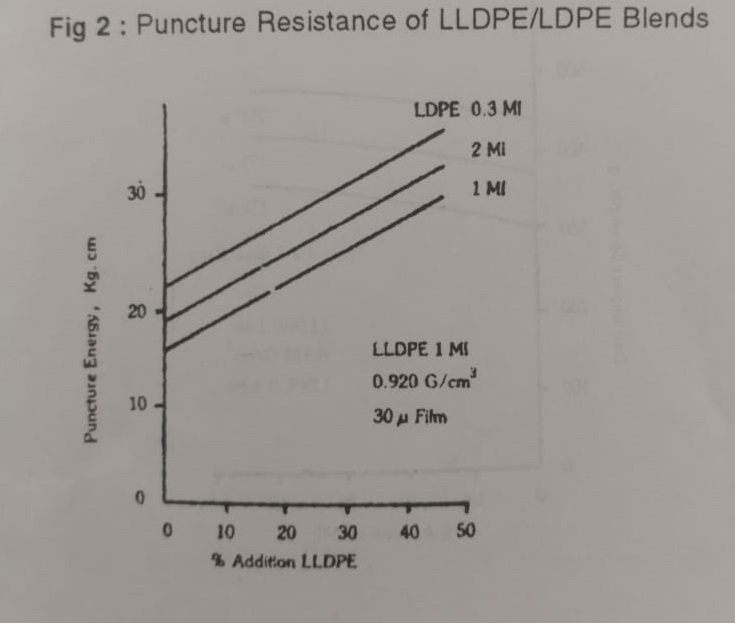
This trend clearly demonstrates that even modest additions of LLDPE can significantly enhance film strength, making blends attractive for demanding packaging applications.
Downgauging Potential: Material Savings Without Performance Loss
One of the most commercially valuable outcomes of improved tensile properties is downgauging.
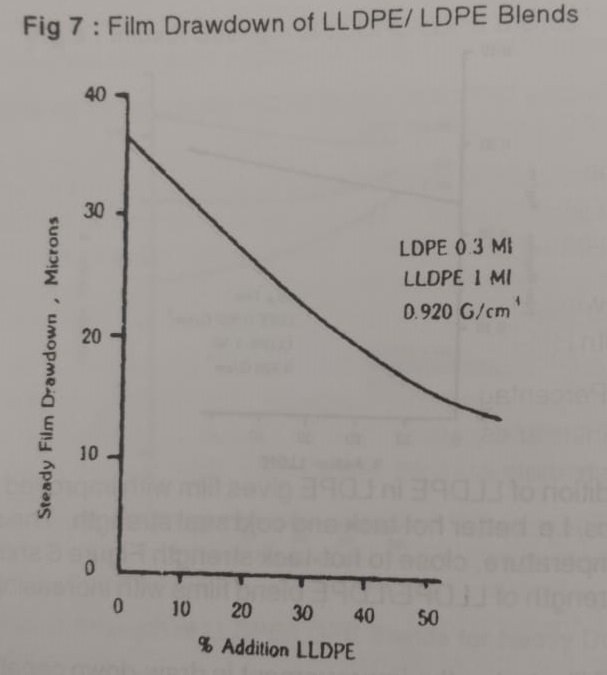
Based on tensile strength improvements observed in LDPE–LLDPE blends, it is possible to achieve up to 20% reduction in film thickness without significant loss of tensile strength for most LDPE grades.
Practical Example
- Original film: 50 microns, 100% LDPE
- Blended film: 40 microns, LDPE + 25% LLDPE
- Result: Comparable tensile strength with 20% material reduction
This downgauging potential directly translates into:
- Lower resin consumption
- Reduced packaging cost
- Improved sustainability metrics
- Increased line output per kg of resin
Tear Strength and Dart Impact: Mixed Performance Trends
While tensile properties show consistent improvement, tear strength and dart impact performance in LDPE–LLDPE blends exhibit mixed results depending on blend ratio, resin grade, and processing conditions.
Tear Strength in Machine Direction (MD)
- LDPE generally exhibits balanced tear properties due to its branched structure.
- LLDPE improves tear strength primarily in the transverse direction (TD).
- In MD, blends may show variable results, sometimes improving and sometimes remaining unchanged.
This behavior underscores the importance of optimizing blend ratios based on the dominant stress direction in the end application.
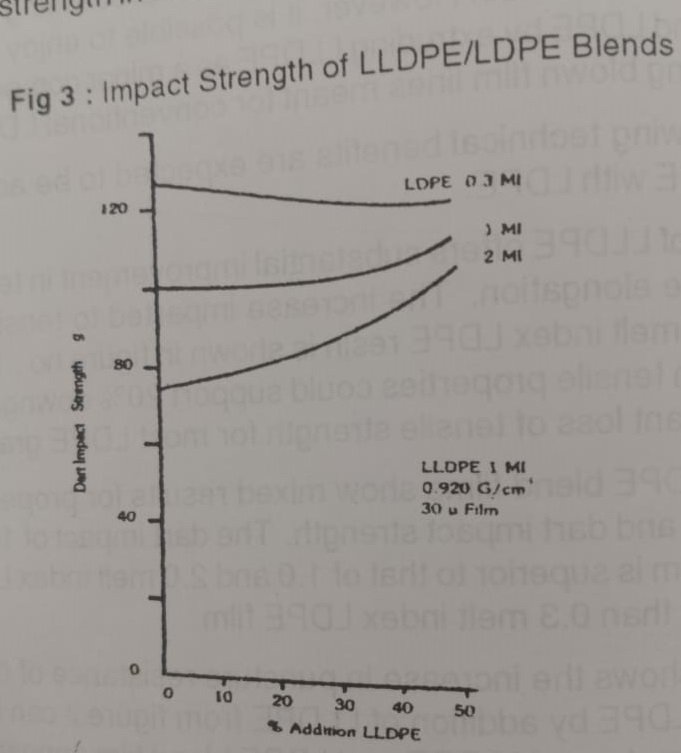
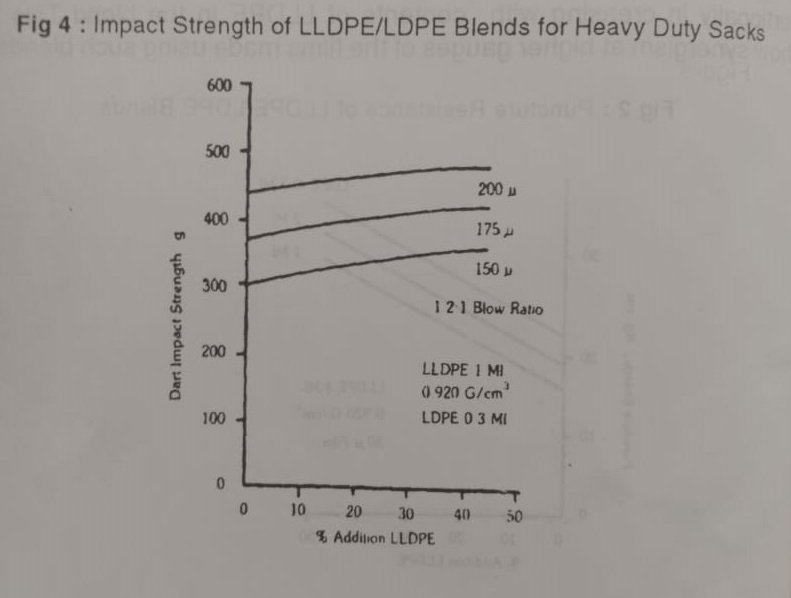
Dart Impact Strength Comparison
Dart impact strength is a critical parameter for packaging films subjected to dynamic loads. Comparative observations include:
- 100% 1.0 MI LLDPE film
- Superior dart impact compared to 1.0 and 2.0 MI LDPE films
- 0.3 MI LDPE film
- Slightly higher dart impact than 1.0 MI LLDPE
- LDPE–LLDPE blends
- Intermediate performance depending on LLDPE content
This indicates that while LLDPE significantly improves impact resistance, very low melt index LDPE grades still retain an advantage in some high-impact scenarios.
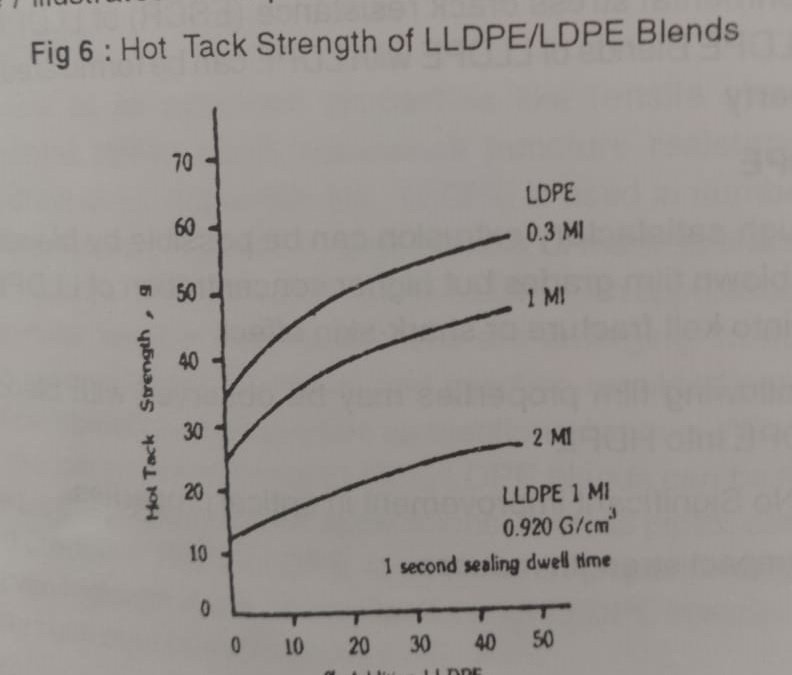
Heat Sealing Performance: A Major Advantage of LLDPE Blends
Another critical benefit of adding LLDPE to LDPE films is improved heat sealing characteristics.
LLDPE contributes to:
- Better hot tack strength
- Higher cold seal strength
- Wider sealing temperature window
- Faster packaging speeds
Why LLDPE Improves Sealing
LLDPE’s uniform molecular structure allows it to:
- Soften more uniformly during sealing
- Develop stronger interdiffusion across seal interfaces
- Retain seal integrity under load
When blended with LDPE, these properties result in films that perform exceptionally well on high-speed form-fill-seal machines.
Environmental Stress Crack Resistance (ESCR)
Environmental Stress Crack Resistance (ESCR) is a critical performance property, particularly for films exposed to oils, detergents, and surfactants.
LLDPE exhibits ESCR values approximately four times higher than LDPE. This dramatic difference stems from:
- Higher molecular weight distribution efficiency
- Reduced susceptibility to craze initiation
- Superior resistance to slow crack growth
By blending LLDPE with LDPE, films can be formulated to significantly enhance ESCR, making them suitable for demanding applications such as:
- Detergent packaging
- Agricultural films
- Industrial liners
- Chemical containment films
Comparative Property Summary
| Property | LDPE | LLDPE | LDPE–LLDPE Blend |
|---|---|---|---|
| Processability on LDPE lines | Excellent | Poor | Excellent |
| Tensile Strength | Moderate | High | High |
| Elongation | Moderate | High | High |
| Downgauging Potential | Limited | High | High |
| MD Tear Strength | Good | Variable | Variable |
| Dart Impact | Moderate | High | Medium–High |
| Heat Seal Strength | Moderate | High | High |
| ESCR | Low | Very High | Improved |
Industrial Application Examples
Example 1: Grocery Carry Bags
By blending 20–30% LLDPE into LDPE, manufacturers achieve:
- Higher load-bearing capacity
- Reduced film thickness
- Improved seal strength
Example 2: Packaging Liners
LDPE–LLDPE blends provide:
- Improved puncture resistance
- Enhanced ESCR
- Stable processing on existing lines
Example 3: Agricultural Films
Blends offer:
- Better tear propagation resistance
- Improved durability under environmental stress
- Cost-effective performance enhancement
Conclusion
While conventional blown film lines are not equipped to handle 100% LLDPE, blending LLDPE as a minor component with LDPE offers a highly effective and economical solution. This strategy enables processors to:
- Retain stable processing conditions
- Improve tensile strength and elongation
- Achieve up to 20% downgauging
- Enhance heat sealing performance
- Significantly improve ESCR
LDPE–LLDPE blends represent a practical bridge between traditional processing capabilities and modern performance requirements. With careful formulation and optimization, processors can unlock the best of both materials—performance without compromise.
Author’s Note: Property outcomes depend on resin grade, melt index, and processing conditions. Trial evaluations are recommended before full-scale production.
About the Author
The author (sujith) is a polymer processing professional with hands-on experience in blown film extrusion and polyolefin formulation. With a strong focus on LDPE and LLDPE film applications, the author specializes in material optimization, downgauging strategies, and performance enhancement using conventional processing equipment. Their work bridges practical shop-floor processing challenges with material science fundamentals, helping converters improve film performance without major capital investment.